Get a Callback
We'll find it for you 💌
Obsessed with this piece? A Mia store expert will call you to help find it nearby.
You're all set!
A Mia store expert will call you shortly to help you find this piece at your nearest store.
Expect a call within 24 hoursDiscover similar or identical jewellery by uploading a picture.
Discover similar or identical jewellery by uploading a picture.
})
The file size should not exceed 5 MB
File size exceeds the limit
























 Blogs & Articles
- Home
- Blogs & Articles
- Are Lab-Grown Diamonds Real? Lab vs Natural Explained
16 Feb 2026

by Mia
16 Feb 2026
Read:
4 Mins
Spread the Fashion Love!


Be the first to see
Explore Mia’s latest jewellery collection, crafted to feel precious, every day!
The catalogue has been sent to you via email!
Be the first to see
Explore Mia’s latest jewellery collection, crafted to feel precious, every day!
The catalogue has been sent to you via email!
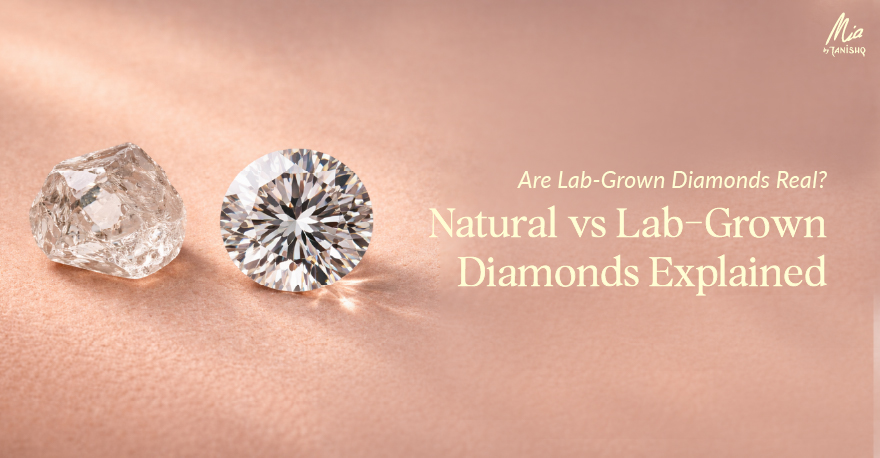

Natural Diamonds & Lab-Grown Diamonds: Understanding Certification and Differences
If you’ve ever paused mid-scroll while browsing jewellery online and wondered, are lab grown diamonds real, you’re not alone. This is one of the most common questions buyers ask today, especially those exploring diamond jewellery for everyday wear, milestone gifts, or meaningful occasions.
The short answer? Yes, lab-grown diamonds are real diamonds. But as with most things in jewellery, the longer answer lies in where its clarity lives. This is where informed choices begin. Let’s talk about what “real” truly means, how certification plays a role, and why natural diamonds continue to hold a distinct place in the world of fine jewellery.
What Makes a Diamond “Real” in the First Place?
From a scientific standpoint, diamonds are defined by their structure. They are basically carbon atoms arranged in a crystal lattice. Lab-grown diamonds, also known as man-made or synthetic diamonds, match this definition exactly.
Mia’s jewellery designer explained it simply: “Think of it like ice; frozen naturally on a lake or made in a freezer. The material is the same. The story is different.”
This difference in story matters more than most people realise.
Lab-Grown Diamonds: The Modern Truth
Now, lab-grown diamonds don’t begin deep within the earth, and that single difference shapes everything that follows. Their journey is designed, monitored, and completed in a matter of weeks, not millennia. Here’s the uncomplicated version.
Lab-grown diamonds are made in controlled laboratory environments. These methods replicate the conditions under which diamonds form in nature, but they do so in weeks and are highly consistent. So yes, when people ask how artificial diamonds are manufactured, the answer is precise engineering, advanced technology, and predictability.
It is worth knowing that lab-grown diamonds are:
not artificial or imitation jewellery
have the same brilliance, hardness, and structure as natural diamonds
recognised as real diamonds by global gemological standards
For most modern women, lab-grown diamonds represent clarity and conscious choice. There’s comfort in knowing where your diamond comes from, how it was made, and what went into it. They resonate with those who value transparency, technology, and intention, without having to give up on beauty.
Why Certification Matters - No Matter the Diamond
Certification is where trust enters the conversation, whether it’s a natural one or a lab-grown diamond. Reputed institutions like GIA and IGI issue certification for lab-grown diamonds. These reports clearly disclose the stone’s origin as a verified record of a diamond’s quality and provenance. For lab-grown diamonds, the certificate explicitly states “lab-grown.” Natural diamonds don’t require this distinction as their origin is implicit. This transparency ensures buyers know exactly what they’re choosing, without ambiguity. From an expert perspective, this disclosure isn’t optional; it’s rather essential. It protects trust in the category.
Natural Diamonds: A Story Written by Time
Natural diamonds are formed deep within the Earth, slowly shaped by heat, pressure, and time. No two natural diamonds are ever identical. Their inclusions, slight variations, and growth marks are part of their identity.
Our gemologist says: “A natural diamond carries time within it. You’re not just wearing a stone; you’re wearing a moment that existed a millennium long before us.”
Natural diamonds are often chosen for their emotional legacy. They become heirlooms passed down through generations, engagement rings that mark beginnings, and milestone gifts that symbolise continuity and permanence, qualities that often outweigh price. For many, a natural diamond represents something enduring, meant for moments that outlast trends. It carries the quiet weight of history and a beauty that can’t be recreated or rushed.
Choosing Between Lab-Grown and Natural Diamonds
There’s no universal answer here. If budget, flexibility, or trend-driven designs are your priority, lab-grown diamonds may suit your needs beautifully. But if longevity, emotional value, and legacy matter more, especially for pieces meant to stay with you for years, natural diamonds offer something deeper than surface sparkle. The best choice is the one aligned with why you’re buying. Here are the factors you should consider:
Initial Cost vs Long-Term Perspective
Lab-grown diamonds are often easier on the wallet at the start, which is part of their appeal. As technology evolves and production becomes more efficient, their prices tend to shift over time. Natural diamonds, on the other hand, are limited by supply and shaped by time itself. That’s why they’re often seen as steadier in long-term value. Simply put, lab-grown diamonds behave like technology, while natural diamonds behave more like resources.
Resale, Rarity, and the Idea of Heirloom
Natural diamonds are often chosen for jewellery meant to stay; engagement rings, milestone gifts, or pieces intended to be passed on. Their rarity plays a role not just in financial value, but emotional significance too. Formed long before us and often staying long after, they carry a sense of continuity that goes beyond trends. When set in thoughtfully crafted jewellery using 14 KT, 9 KT, or 18 KT gold, that permanence is paired with everyday comfort, making the piece both meaningful and wearable.
Choosing with Confidence
Diamonds today come from different origins, but meaning isn’t manufactured. It’s felt over time, in how often a piece is worn, how comfortably it fits into your life, and what it quietly comes to represent. Understanding the difference helps you choose not just what looks right, but what feels right. It allows you to choose with intention, balancing value, emotion, and longevity in a way that aligns with your life.
Frequently Asked Questions
1. Are lab-grown diamonds real diamonds or fake ones?
They are real diamonds chemically and structurally, but they differ in origin from natural diamonds.
2. Can jewellers tell the difference between lab-grown and natural diamonds?
Yes. Advanced testing and certification clearly identify a diamond’s origin.
3. Do lab-grown diamonds lose value over time?
Generally, yes. Their resale value tends to be lower compared to natural diamonds.
4. Is certification mandatory for lab-grown diamonds?
Reputable lab-grown diamonds are always certified and clearly labelled as such.
5. Why are natural diamonds still preferred for engagement rings?
Many buyers value their rarity, emotional significance, and long-term worth.
Stories you might also like




×