Get a Callback
We'll find it for you 💌
Obsessed with this piece? A Mia store expert will call you to help find it nearby.
You're all set!
A Mia store expert will call you shortly to help you find this piece at your nearest store.
Expect a call within 24 hoursDiscover similar or identical jewellery by uploading a picture.
Discover similar or identical jewellery by uploading a picture.
})
The file size should not exceed 5 MB
File size exceeds the limit



















































 Blogs & Articles
- Home
- Blogs & Articles
- How To Test Gold Purity
28 Aug 2026

by Mia
28 Aug 2026
Read:
4 Mins
Spread the Fashion Love!


Be the first to see
Explore Mia’s latest jewellery collection, crafted to feel precious, every day!
The catalogue has been sent to you via email!
Be the first to see
Explore Mia’s latest jewellery collection, crafted to feel precious, every day!
The catalogue has been sent to you via email!
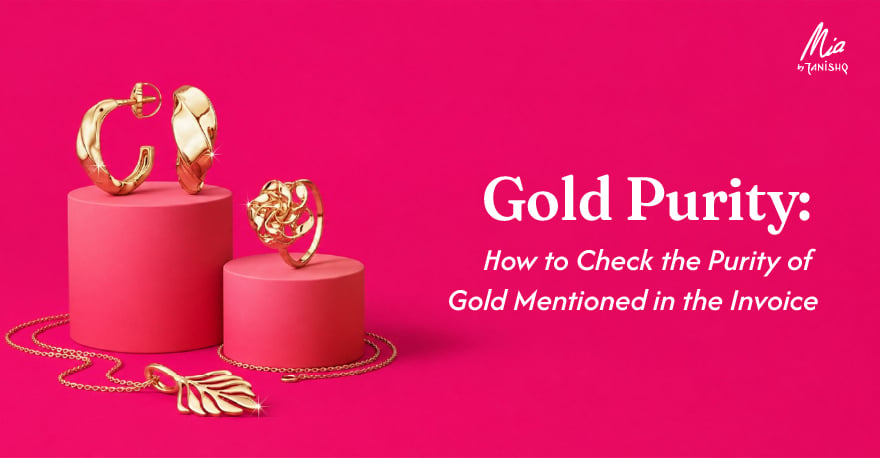

Gold Purity: How to Check the Purity of Gold Mentioned in the Invoice
Planning to independently invest in gold jewellery this year? It’s a huge personal milestone that must be approached mindfully. Make sure to verify the purity of gold mentioned on your invoice as a priority. Cross-refer the invoice pointers with the stamped physical hallmarks on your jewellery.
The invoice must explicitly state the exact ‘karatage’ (e.g., 22KT, 18 KT or 14KT), fineness numbers and net weight. You can also verify the digital trace of the gold on the BIS Care App. Discover more about how to test gold purity so you can be sure-footed with your gold purchases.
How to Check Gold Jewellery Purity?
You can check the purity of gold jewellery by examining the product for an official hallmark stamp (e.g., the BIS logo and a 6-digit HUID code). Verify the HUID using the BIS Care App.
For a precise reading, visit us at Mia by Tanishq to test the piece using a Karatmeter/XRF machine.
1. 24 Karat Gold Purity Percentage
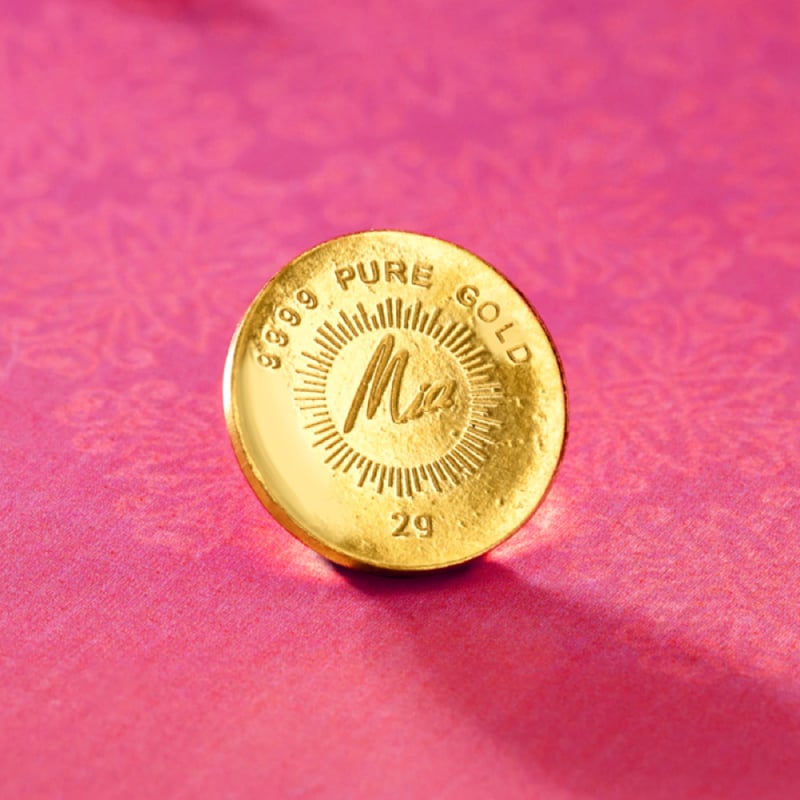
To verify 24 KT (99.9% pure) gold, the most definitive way is to have it evaluated by a certified jeweller using a Karatmeter or XRF machine. For immediate 24 KT gold coin verification, check for official hallmarks with fineness stamps quoting ‘999’.
2. 22 Karat Gold Purity Percentage
Wondering how to check the purity of 22 KT gold? Simply look for the official BIS hallmark stamp which specifies ‘916’. This marking indicates 91.6% gold purity. Further verify the 6-digit alphanumeric HUID code.
3. 18 Karat Gold Purity Percentage
18 karat or 18 KT gold has a purity percentage of 75%. This means it contains 18 parts pure gold and 6 parts other metals (e.g., copper or silver) out of 24 parts. Look for the fineness mark of ‘750’.
4. 14 Karat Gold Purity Percentage
14 karat gold contains exactly 58.33% pure gold, which is 14 parts out of a total of 24. It's mixed with 41.67% of other metals, which contribute to its overall durability. To check its authenticity and exact purity, find official stamps specifying 14K/585 purity, verify certifications, or resort to professional testing methods.
5. 9 Karat Gold Purity Percentage
To verify 9 Karat gold purity, check for the ‘375’ hallmark stamp. 9 KT gold base consists of 37.5% pure gold and 62.5% other metals. You can reliably verify its authenticity using methods ranging from at-home checks to professional analysis.
If you are wondering how to determine the purity of gold at home, you can use a trusted acid test kit, though DIY density/streak tests can also help tell fakes apart from real gold products. Learn more about these methods in the next segment.
How to Check the Gold Authenticity at Home?
To check the authenticity of your gold products at home, start by looking for hallmark stamps (e.g., 916 for 22K). Next, test to see if the metal base reacts to a strong magnet. You can also perform a quick ceramic scratch test.
1. Magnet Test
 Step 1: Hold a strong neodymium magnet at close proximity to your gold item.
Step 2:See if it is strongly attracted or sticks to the magnet.
Analysis: Genuine gold is non-magnetic. So, if the gold product gets attracted to the magnet, it’s likely a fake or a heavily-plated base metal.
2. Ceramic Scratch Test
Step 1: Hold a strong neodymium magnet at close proximity to your gold item.
Step 2:See if it is strongly attracted or sticks to the magnet.
Analysis: Genuine gold is non-magnetic. So, if the gold product gets attracted to the magnet, it’s likely a fake or a heavily-plated base metal.
2. Ceramic Scratch Test
 Step 1: Gently rub the gold product against an unglazed ceramic plate/tile.
Step 2: Check to see whether or not it leaves a yellow streak.
Analysis: Real gold will leave a yellow streak. However, in case it leaves behind a black/grey mark, the product is likely made of a different metal.
Note that at-home methods aren't 100% accurate. However, they are best used to screen for fakes prior to visiting professionals. In our store, we can help you identify the purity of your gold jewellery via karatmeter and it free! What you need to do is to take your old gold and bring to our store.
How to Check Hallmark Gold?
To check hallmark gold purity in India, make sure that your jewellery has 3 mandatory marks. These include the BIS triangular logo, the purity grade (e.g., 916 for 22K, 750 for 18K), and the 6-digit alphanumeric HUID code. You can also instantly verify the HUID code online to confirm your gold's authenticity.
Here are the steps to check the gold hallmark online:
1. Verify the Gold HUID Online
Step 1: Use the Mobile App to cross-check the gold HUID. Start by downloading and opening the official BIS Care App, available on Android and iOS.
Step 2: Navigate to the ‘Verify HUID’ option.
Step 3: Enter the 6-digit code and submit it to view the jeweller's details, hallmarking centre, and purity level of gold.
2. Verify Via the Official Website
Step 1: Visit the BIS eBIS Hallmarking Portal.
Step 2: Enter the 6-digit HUID code in the designated search field in order to authenticate the order’s details.
Final Word
The invoice you receive is your source of proof, so use it for clarity. At this point, you must know how to test gold purity. For instance, 916 for 22K or 750 for 18K should be mentioned. Plus, match the quotes with the BIS hallmark and HUID code stamped on the jewellery itself.
If the numbers line up and the HUID verifies online, you’ll be empowered with the knowledge about exactly what you paid for. Taking two minutes out to cross-check this information can protect your purchase. Thus, it’ll give you confidence every time you wear your investment.
At Mia by Tanishq, we extend a range of hallmarked gold jewellery across various styles. Beyond nailing the aesthetics, we also prioritise clarity on your end and your peace of mind at the time of purchase.
Step 1: Gently rub the gold product against an unglazed ceramic plate/tile.
Step 2: Check to see whether or not it leaves a yellow streak.
Analysis: Real gold will leave a yellow streak. However, in case it leaves behind a black/grey mark, the product is likely made of a different metal.
Note that at-home methods aren't 100% accurate. However, they are best used to screen for fakes prior to visiting professionals. In our store, we can help you identify the purity of your gold jewellery via karatmeter and it free! What you need to do is to take your old gold and bring to our store.
How to Check Hallmark Gold?
To check hallmark gold purity in India, make sure that your jewellery has 3 mandatory marks. These include the BIS triangular logo, the purity grade (e.g., 916 for 22K, 750 for 18K), and the 6-digit alphanumeric HUID code. You can also instantly verify the HUID code online to confirm your gold's authenticity.
Here are the steps to check the gold hallmark online:
1. Verify the Gold HUID Online
Step 1: Use the Mobile App to cross-check the gold HUID. Start by downloading and opening the official BIS Care App, available on Android and iOS.
Step 2: Navigate to the ‘Verify HUID’ option.
Step 3: Enter the 6-digit code and submit it to view the jeweller's details, hallmarking centre, and purity level of gold.
2. Verify Via the Official Website
Step 1: Visit the BIS eBIS Hallmarking Portal.
Step 2: Enter the 6-digit HUID code in the designated search field in order to authenticate the order’s details.
Final Word
The invoice you receive is your source of proof, so use it for clarity. At this point, you must know how to test gold purity. For instance, 916 for 22K or 750 for 18K should be mentioned. Plus, match the quotes with the BIS hallmark and HUID code stamped on the jewellery itself.
If the numbers line up and the HUID verifies online, you’ll be empowered with the knowledge about exactly what you paid for. Taking two minutes out to cross-check this information can protect your purchase. Thus, it’ll give you confidence every time you wear your investment.
At Mia by Tanishq, we extend a range of hallmarked gold jewellery across various styles. Beyond nailing the aesthetics, we also prioritise clarity on your end and your peace of mind at the time of purchase.
Frequently Asked Questions
1. How to check the purity of gold coins?
Checking the purity of a gold coin requires verifying its hallmark certification/using simple physical tests. The most reliable method is searching for the hallmark stamp (like '916' for 22K) and checking the 6-digit alphanumeric HUID code. At Mia, we use a Karatmeter to scan the coin in seconds to prove the purity accuracy.
2. How to check the purity of gold ornaments with physical DIY tests?
Check the purity of gold ornaments at home using easy, non-destructive DIY methods like the magnet test. See if the products contain the relevant base metals. Or, conduct a vinegar test acting as a mild acid check. However, note that these only test if the piece is genuine gold. You cannot verify the exact karat purity through them.
3. Does every gold jewellery piece in India require a HUID code?
Yes, according to BIS guidelines, all hallmarked gold jewellery must have the BIS logo, purity grade and 6-digit HUID code. If your invoice is recent and the jewellery does not have a HUID, question your jeweller why and possibly avoid buying from them again.
4. What happens if my old gold jewellery does not have a HUID code?
Gold jewellery bought before HUID became mandatory may only display the old 4-mark hallmark, which is still valid. However, you can get it re-hallmarked with HUID for easier verification/resale.
Stories you might also like





×