Get a Callback
We'll find it for you 💌
Obsessed with this piece? A Mia store expert will call you to help find it nearby.
You're all set!
A Mia store expert will call you shortly to help you find this piece at your nearest store.
Expect a call within 24 hoursDiscover similar or identical jewellery by uploading a picture.
Discover similar or identical jewellery by uploading a picture.
})
The file size should not exceed 5 MB
File size exceeds the limit























 Blogs & Articles
- Home
- Blogs & Articles
- Lab Grown Diamonds Vs. Natural Diamonds
30 Dec 2025

by Mia
30 Dec 2025
Read:
4 Mins
Spread the Fashion Love!


Be the first to see
Explore Mia’s latest jewellery collection, crafted to feel precious, every day!
The catalogue has been sent to you via email!
Be the first to see
Explore Mia’s latest jewellery collection, crafted to feel precious, every day!
The catalogue has been sent to you via email!
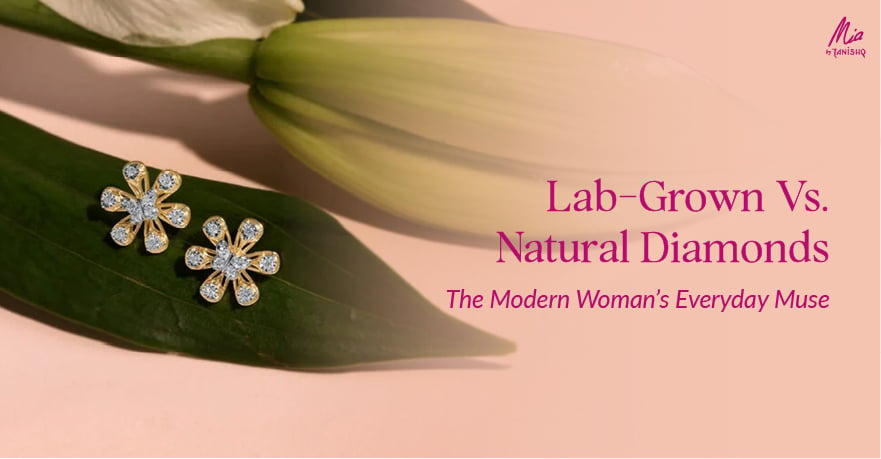

Lab-Grown Vs. Natural Diamonds: Everything You Need to Know as a Modern Buyer
Caught up at the crossroads hosting the eternal debate between sentiment-rich natural diamonds vs. sometimes-cheaper lab-grown alternatives? While both are considered to be real diamonds with seemingly identical brilliance and chemical composition, their origin stories are vastly different.
Weigh the pros and cons in order to discover which is the right choice for you at this stage of life. Depending on priorities like knack for sentimental value, sustainability and affordability, crown your winner!
Lab Gown Diamonds Vs. Natural Diamonds: A Brief Overview
You’re already aware of the classic, captivating aura of natural diamonds. They are forever, and considered to be beauty-seekers’ most treasured finds!
Natural diamonds come from nature, deep within the earth's mantle, forming over billions of years. Intense heat and pressure transform the carbon into crystalline diamonds, each piece uniquely embodying its tale of genesis.
However, you may be wondering what a lab-grown diamond exactly is, on the other hand. They are formed through advanced technology, which replicates the same conditions found beneath the earth. Carbon atoms essentially bond around a tiny diamond seed, through the HPHT (High Pressure, High Temperature) or CVD (Chemical Vapour Deposition) methods. This results in gemstone formation with the identical chemical composition and optical appeal as the mined diamonds.
Now, let’s get into the differences between lab-grown diamonds vs. natural diamonds so you can understand your contenders better:
What Makes Natural Diamonds More Desirable & Superior in 2026?
With a better understanding of the differences between natural diamonds and lab-grown diamonds, you must be wondering what makes the former more appealing. What is that natural diamond benefit that makes it a winner against lab-grown alternatives, in the eyes of aesthetic-seeking fashionistas? Let’s discuss below:
1. Natural Diamonds Are Rare & Unique Like Unconditional Love
Just like how there's no other like your beloved, no two natural diamonds are exactly the same. In fact, the gemstones cannot be mass-produced as per demand, like lab-grown diamonds. To bask in their rarity and glory, billions of years and generations come together to uphold the birth of each gem.
Natural diamonds are unique even in the context of modern jewellery, with a history and romanticised timeline backing up their sparkling existence. Realistically, there’s nothing too romantic about a mass-produced diamond coming from a lab. So, it’s easy enough to deduce why the lover’s heart inclines towards the naturally occurring deal!
2. Natural Diamonds Are Associated with Lower Carbon Emissions
In this decade, individual consumers are basing their purchase decisions on sustainable missions more than ever. The carbon emissions associated with synthetic diamonds are 3x higher than those resulting from naturally-mined diamonds. Across several laboratories and factories, synthetic diamonds need electricity from fossil fuels, and particularly so in India, among other countries.
Within the background of mining industries, though, diamonds are separated from rocks with reliance on recycled water at high pressure. Across certain mines, up to 83% of the water used up during natural mining processes is recycled.
3. Natural Diamonds Are Emotionally & Generally More Valuable
We are talking about impact beyond sentiments; diamonds are associated with a value that stands the test of time. In fact, their higher cost is part of the sparkling appeal, especially when lovers want to splurge on and pamper their beloved.
On the other hand, what you pay for grown diamonds today shall be much more than what you could possibly sell them for later. So, the question lingers on, ‘Is the lower price really worth it?’ You decide!
4. Natural Diamonds Vs. Lab-Grown Diamonds: Who is the Worthy Winner?
You can choose to invest in either form of sparkling jewellery, but one comes with a rarer storyline and timeless appeal. It’s easy to see how natural diamonds, which are produced mystically beneath the earth over the years, shall always remain more valuable and precious.
Especially, when you’re gifting to your beloved person, it must be primary for you to stress their rarity and unique importance in your life. This notion lines up with the naturally formed diamonds' backstory. Celebrate love that cannot be mass-produced in factories, even in the uber-technological world of today!
With us, at Mia by Tanishq, discover natural diamond jewellery at prices across various budgets. Whether you’re looking for diamond-studded presents under ₹10K, ₹50K or ₹1 lakh, we’ve got your back with several options!
| Condition | Natural Diamonds | Lab-grown Diamonds |
| Formation Process | Formed deep within the earth’s surface over billions of years through pressure and naturally occurring heat | Grown within a controlled environment through HPHT or CVD methods, the conditions mirror the same ones taking place naturally underground |
| Composition | Pure carbon, which has been placed in a crystal lattice | Identical pure carbon structure, created at the lab |
| How They Look | Portrays the natural inclusions as they are shaped by pressure and time | Shall show minute growth features on the basis of the method undertaken; however, they are typically not visible in the absence of magnification tools |
| Standards Set for Quality | Certified by recognised laboratories like GIA or IGI | Certified by the same recognised labs and judged against identical criteria, like colour, cut, carat and clarity |
| Price Point | Higher due to rarity and a geologically significant history | Usually lower, as they are easily accessible; they can be spontaneously produced on demand |
| Rarity Factor | High as their availability is, it is limited to the Earth's natural creations | Comparatively low, as they can be created any time and endlessly in the labs by mimicking natural processes |
| Durability | Highly durable and ideal for everyday wear | Equally durable with more or less indistinguishable performance |
| Best for | Marking milestone moments and if you value rarity, a great gifting option that conveys heaps of emotion, for everyday style enthusiasts | Everyday style enthusiasts who are shopping on a budget |
| Return Value | Much higher resale value because it is rare and has limited supply | Lower resale value as it can be mass produced based on demand |
| Uniqueness | Each diamond is just as unique as you; every shine is a one-in-million type | Typically identical as they are mass-produced at the lab |
| Industrial Use | Not meant for industrial use | Have industrial use in tech, optics, etc. |
Frequently Asked Questions
1. Where can I buy authentic natural diamond jewellery?
You can purchase authentic, certified natural diamond jewellery from us. Check out our catalogue of stunning jewellery online or visit us offline to try on the magic before buying.
2. Which natural diamond jewellery options are trendy right now?
Natural diamond jewellery categories like minimally-crafted pendants, versatile rings and lightweight earrings are incredibly trendy right now. Their timeless appeal, combined with the ease of styling, makes them perfect for everyday wear.
4. Which gold type suits pinkish skin undertones?
14 KT gold complements pinkish or cooler skin undertones. Its typical polished finish and understated radiance universally go with all skin undertone types.
5. Are 14 KT and 22 KT gold hypoallergenic?
Both of our 14KT gold and 22KT gold jewellery categories are hypoallergenic. You can wear them daily or on special occasions without worrying about triggering allergic reactions.
Stories you might also like




×