Get a Callback
We'll find it for you 💌
Obsessed with this piece? A Mia store expert will call you to help find it nearby.
You're all set!
A Mia store expert will call you shortly to help you find this piece at your nearest store.
Expect a call within 24 hoursDiscover similar or identical jewellery by uploading a picture.
Discover similar or identical jewellery by uploading a picture.
})
The file size should not exceed 5 MB
File size exceeds the limit





















 Blogs & Articles
- Home
- Blogs & Articles
- Comparison between 9KT and 22KT Gold Jewellery
10 Dec 2025

by Mia
10 Dec 2025
Read:
4 Mins
Spread the Fashion Love!


Be the first to see
Explore Mia’s latest jewellery collection, crafted to feel precious, every day!
The catalogue has been sent to you via email!
Be the first to see
Explore Mia’s latest jewellery collection, crafted to feel precious, every day!
The catalogue has been sent to you via email!
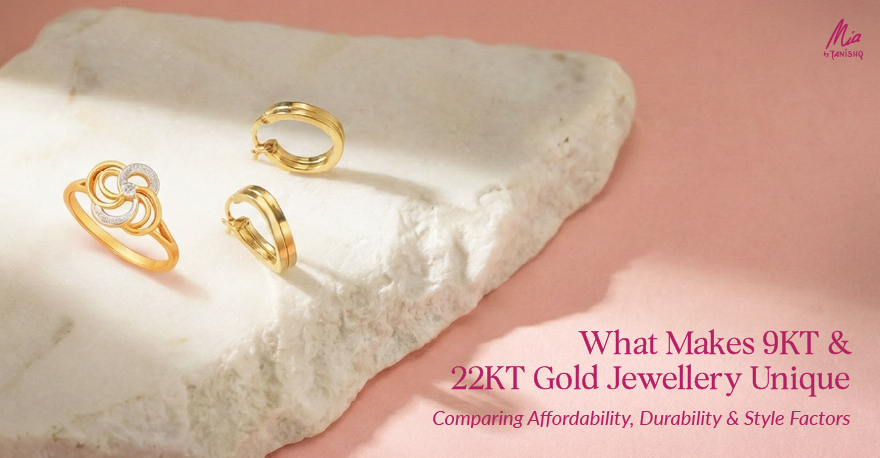

What Makes 9KT & 22KT Gold Jewellery Unique: Comparing Affordability, Durability & Style Factors
Are you considering making your first gold jewellery purchase independently? Investing in valuable gold jewellery is indeed a meaningful and wise way to celebrate big life moments.
As gold is historically known to appreciate in value, it is the ultimate investment option and aesthetic catharsis medium. However, for first-time buyers, it might be tricky to figure out which purity of gold best matches their unique requirements. This blog shall highlight the differences between 9KT and 22KT gold, so you can jot down your priorities
What Makes 9KT Gold Jewellery Special?
9 karat gold is essentially composed of an alloy of gold and various other metals, typically consisting of copper, nickel, silver and zinc. Consider the ratio to be 9 parts out of 24 pure gold. This signifies that the concoction is made up of 37.5% pure gold.
9 karat gold is the most affordable form of gold jewellery available in the market and is also the most durable variant. As it is associated with a lower gold purity level, jewellery made from 9KT gold is rather affordable. 9KT gold appears more copper-toned in usual cases.
However, if you check out our collection of 9 KT gold jewellery, the sheen is going to captivate you at once! Our pieces are coated with an anti-tarnish polish, which makes their radiance last a long time.
What Makes 22KT Gold Jewellery So Popular?
22 KT gold is another alloy of gold and other metals, the latter typically consisting of silver and copper. This variant consists of 22 parts of gold and 2 parts of metal. This means it is 91.67% pure gold.
22KT gold is valuable, but it is also not as durable as its 18KT, 14KT or 9KT counterparts. So, it is not usually the first preference when it comes to daily wear pieces. 22KT gold jewellery has a more orangey-leaning, bright yellow tone. These pieces are more preferred as investment options to fulfil long-term wealth preservation goals.
9KT vs. 22KT Gold: Key Points of Differences
The goals of investing in either 9KT gold or 22KT gold are ultimately different. While the former shall be an affordable investment in everyday style elevation, the latter is suited to ambitious investment goals and traditional design choices. Here’s a table listing the differences between these metals for your in-depth understanding of what you’re getting into:
9KT vs. 22KT Gold: Which One is Better for Gifting?
The goals of investing in either 9KT gold or 22KT gold are ultimately different. While the former shall be an affordable investment in everyday style elevation, the latter is suited to ambitious investment goals and traditional design choices. Here’s a table listing the differences between these metals for your in-depth understanding of what you’re getting into:
When it comes to selecting between 9KT gold and 22KT gold, decide what you want to convey, your budget and consider the gift recipient's style. Choosing 9KT gold would be the better route when your priorities are:
1. Budgeting : 9KT gold is more affordable. So, if you’re looking to convey your heartfelt well-wishes via a valuable gift on a budget, 9KT gold shall be an excellent option. Express your genuine realness with an affordable gift without compromising on the quality of emotion or gold quotient.
2. Ensuring Durability : Consisting of a mix of 37.5% pure gold and other metals, 9KT gold shall be resistant to the scratches that are synonymous with daily life.
3. Investing in Minimalist Styles : 9KT gold options are perfect for everyday wear, available in various designs. If your recipient prioritises infusing an understated elegance to her everyday outfits, this category is your winner.
4. Shopping for Gen-Z : The Gen-Z is constantly on its feet, getting things done and prioritising productivity. Comfortable and lightweight jewellery crafted from 9KT gold shall be the perfect companion for their daily rendezvous!
Next, the 22KT gold category shall be more suitable for gifting if you’re eyeing:
1. High Gold Purity : 22KT gold jewellery is 91.6% pure, which makes it a high-end and valuable gift option. If you’re gifting to your wife, a sibling or a special mentor, 22KT gold gifts would convey heaps about how you truly feel.
2. Aesthetic Beauty : We offer an inclusive range of 22KT gold jewellery options embodying a rich and vibrant appeal, while being trend-adjacent. Opt for classic hits elevated with modern, artisanal strokes, perfect for gifting on special occasions.
3. A Worthy Investment : 22KT gold is a fool-proof investment option as it retains its value endlessly, over time. You can gift 22KT gold jewellery as a way to convey your manifestations of an abundant future for your recipient.
| Condition | 9KT Gold Jewellery | 22KT Gold Jewellery |
|---|---|---|
| Purity | 37.5% pure gold; a ratio of 9 parts gold to 15 parts alloy | 91.6% pure gold; a ratio of 22 parts gold to 2 parts alloy |
| Durability | • Very strong and durable owing to the high alloy content • Resistant to scratches, dents and bending | • Softer in comparison to 9 KT gold, but sturdier than 24KT pure gold • Prone to scratching and bending, especially if the jewellery features intricate designs |
| Colour | Typically a paler yellow tone owing to less pure gold content | Vibrant, radiant golden-yellow colour |
| Affordability | Less expensive due to lower intrinsic gold value | More expensive due to higher intrinsic gold value |
| Best Suited For | Daily wear jewellery like minimalist pendants, rings and bracelets where durability and versatility are key | Traditional patterned high-value jewellery; investment with the aim of wealth building in the long run |
| Resale Value | Lower because its value is primarily dependent on the precision of craftsmanship, not so much on the gold value | Higher because its value is ultimately closely connected to gold’s market price |
| Style | Used for modern & trendy jewellery designs for everyday wear | Used in more traditional styles |
| Sustainability Factor | More sustainable, as these pieces are durable and can be used every day | Comparatively less sustainable, as these pieces are mainly kept aside for special events |
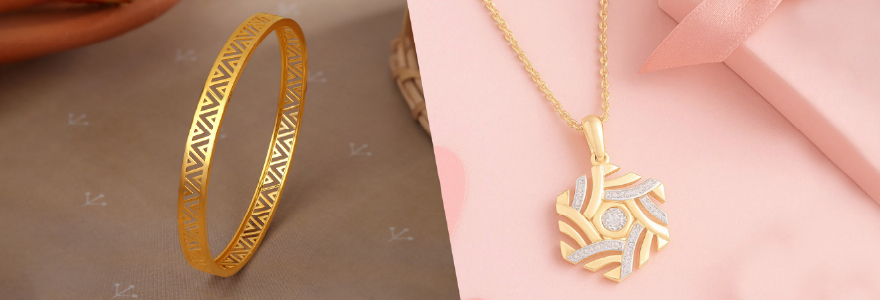
Final Word on 9KT vs. 22KT gold: Which One’s for You?
When it comes to choosing between 9-karat gold and 22-karat gold, the key is to break down your goals with the investment. If you want to buy gold jewellery which you can wear every day, everywhere, 9KT gold stands out as a time-withstanding and durable option. On the other hand, if you're looking to invest in high-value jewellery offering more scope for wealth preservation, 22KT gold is your winner.
Frequently Asked Questions
1. Is 9KT gold jewellery going to tarnish quickly?
Our 9KT gold jewellery pieces have an anti-tarnish, protective coating. So, they shall retain their shine for years to come with proper care.
2. Can I only find traditional heavy designs in 22KT gold?
At Mia by Tanishq, you can find modern and lightweight 22KT gold jewellery, which shall appeal to the minimalist eye. Our designs are not limited to traditionally accepted moulds, only!
3. Can I layer 22KT gold and 9KT gold & diamond jewellery together?
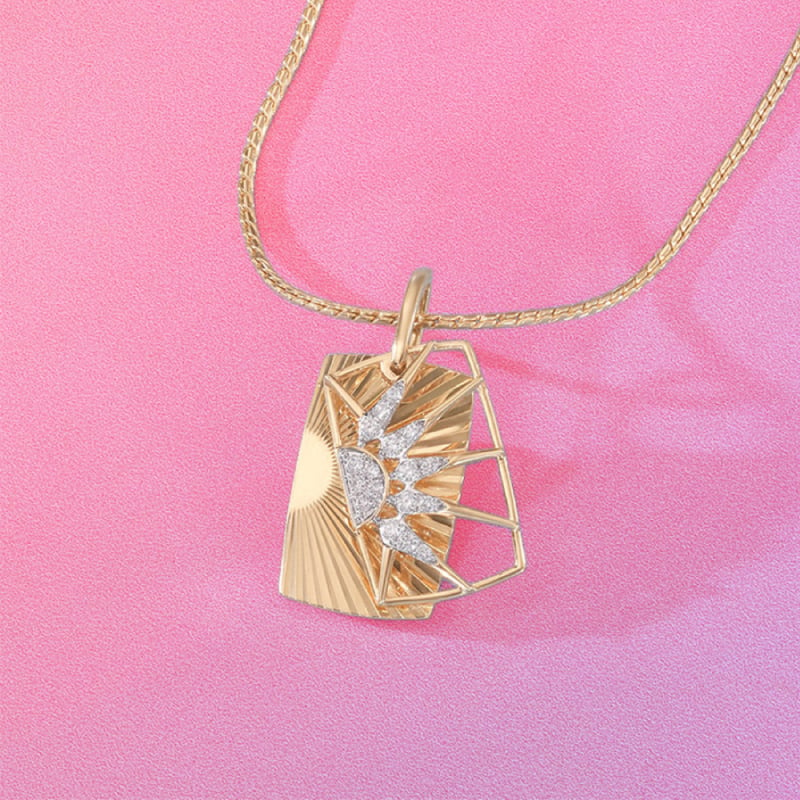
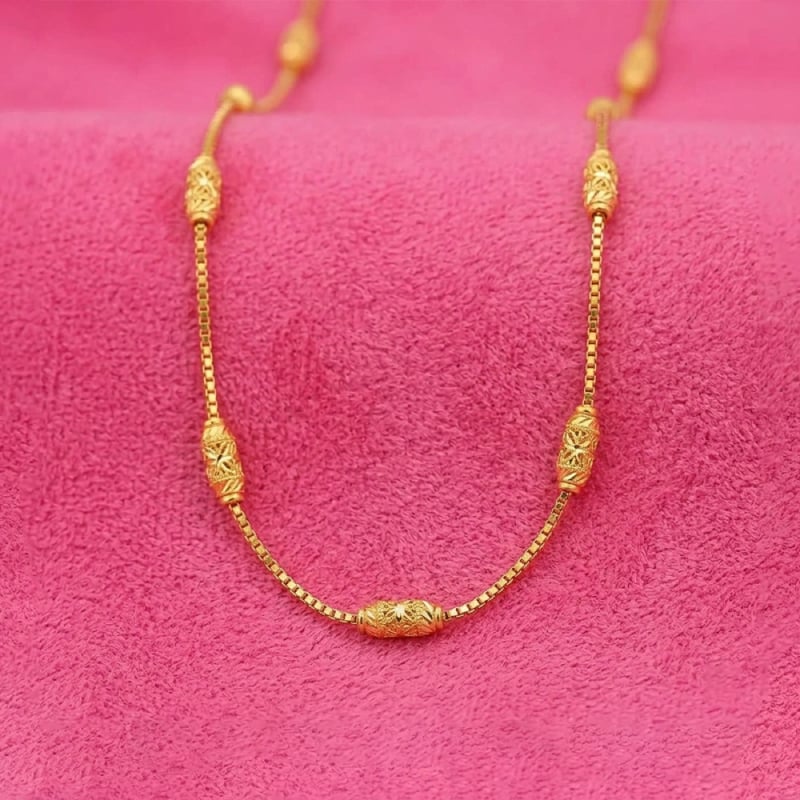
Yes, you can pair classic 22KT gold chains with intricate 9KT gold and diamond pendants for a sleek and stylish look. Thus, it embodies timeless elegance, accentuated by the gleam of diamonds.
Stories you might also like




×