Get a Callback
We'll find it for you 💌
Obsessed with this piece? A Mia store expert will call you to help find it nearby.
You're all set!
A Mia store expert will call you shortly to help you find this piece at your nearest store.
Expect a call within 24 hoursDiscover similar or identical jewellery by uploading a picture.
Discover similar or identical jewellery by uploading a picture.
})
The file size should not exceed 5 MB
File size exceeds the limit











































 Blogs & Articles
- Home
- Blogs & Articles
- How to Identify a Rough Diamond From Rock
12 Feb 2026

by Mia
12 Feb 2026
Read:
4 Mins
Spread the Fashion Love!


Be the first to see
Explore Mia’s latest jewellery collection, crafted to feel precious, every day!
The catalogue has been sent to you via email!
Be the first to see
Explore Mia’s latest jewellery collection, crafted to feel precious, every day!
The catalogue has been sent to you via email!
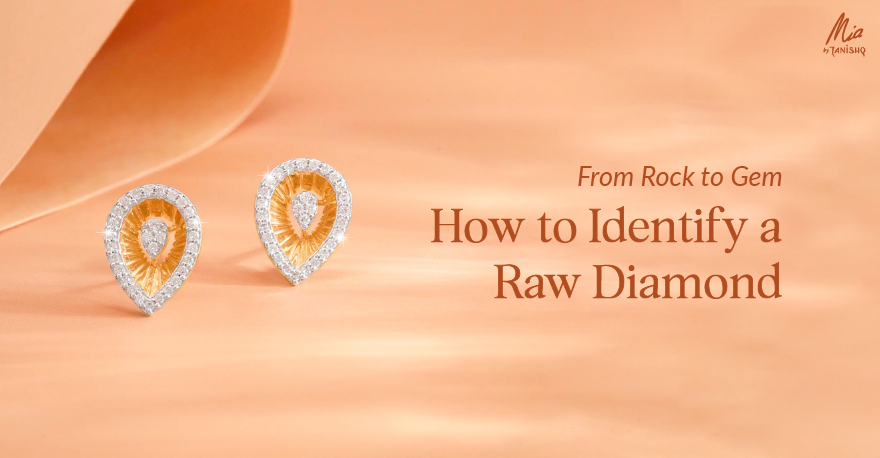

From Rock to Gem: How to Identify a Raw Diamond
At first glance, a rough diamond doesn’t look like something you’d expect to wear every day. It doesn’t sparkle, it isn’t perfectly shaped, and it can easily pass for just another stone. But every brilliant diamond you admire today was once a rough diamond, raw, unpolished and unknowingly powerful. Identifying a raw diamond is less about dramatic tests and more about understanding nature, material science, and a little patience.
Let’s break it down in a simple way.
What Does a Rough Diamond Really Look Like
One of the biggest misconceptions about diamonds is that they’re born shiny. In reality, a rough diamond looks more like a dull crystal than a finished gem. It has uneven surfaces, sharp natural edges, and a slightly greasy or oily appearance rather than a glassy shine.
When people ask how to identify a rough diamond, they’re usually surprised to learn that clarity comes later. It’s interesting to know that a diamond in its raw form can be translucent or cloudy and may even carry a yellow or brown tint. These natural colour variations are common and do not reduce its value. This is also why many rough diamonds are mistaken for quartz or other clear minerals. The difference lies not in beauty, but in the stone's behaviour.
The Science That Sets Diamonds Apart
Beyond how a stone looks, a diamond is distinguished from other stones by how it behaves under real-world conditions. A key way experts identify diamond rock is by observing physical properties that are difficult to fake.
Diamonds are the hardest natural material on Earth, ranking 10 on the Mohs hardness scale. This means they resist scratches far better than lookalike stones. They’re also unusually dense, so a small rough diamond feels heavier than expected when compared to similar-sized minerals.
Another defining trait is heat conductivity. Natural diamonds disperse heat extremely quickly. This is a property that gemologists rely on during professional testing. This is why visual inspection alone is rarely enough, and why most at-home methods can be misleading.
Well! Here’s a fun fact:
Diamonds conduct heat about five times faster than copper, which is why thermal conductivity testers are commonly used in gemology.
Why Are Rough Diamonds Often Confused With Ordinary Stones
If you’ve ever wondered how to identify a rough diamond among ordinary stones, the confusion is understandable. Many stores widely available use stones like cubic zirconia, intentionally designed to visually mimic diamonds, making the distinction even harder without proper knowledge.
Minerals like quartz, zircon, and calcite often appear similar in their raw state. They can be transparent, angular, and crystal-like. The difference is subtle but important.
Quartz scratches easily compared to diamonds.
Calcite reacts differently to pressure and breaks along flat planes.
Zircon, while heavier than quartz, lacks the same hardness and thermal properties.
This is where experience matters. Professional gemologists don’t rely on a single test; they consider structure, surface texture, weight, and response to tools together.
Natural vs Lab-Grown: Does Rough Identification Change?
With lab-grown diamonds becoming more common, one common question naturally comes up: Does rough identification differ between natural and lab-grown diamonds?
Visually, in their rough state, lab-grown and natural diamonds can look remarkably similar. Both share the same chemical composition and hardness. However, lab-grown diamonds often have more uniform shapes and fewer surface irregularities because they’re created in controlled environments.
Natural diamonds, on the other hand, carry geological fingerprints. They carry irregular growth patterns formed over billions of years beneath the Earth’s surface.
According to GIA, laboratory-grown diamonds are optically and chemically similar to natural diamonds but can be distinguished using advanced testing. However, for everyday buyers, this distinction isn’t about “better” or “worse.” It ensures transparency, informed choice, and knowing the story behind the stone.
Why Does Expert Verification Always Matter
While surface clues can spark curiosity, identifying a rough diamond with certainty requires trained eyes and specialised tools. This is where professional gemologists come in. Their role isn’t just to confirm whether a stone is a diamond, but to understand its structure, origin, and potential, long before it’s cut or polished.
“No single characteristic is enough to identify a rough diamond. It’s the combination of how the stone looks, feels, and responds to testing that builds confidence in what you’re seeing. If a stone looks convincing but doesn’t behave like a diamond under testing, we rule it out quickly.” Category manager - Mia by Tanishq
Visual Examination by Gemologists
The first step is always careful observation. Gemologists use magnifying tools such as loupes and microscopes to study a stone’s surface and internal characteristics. Under magnification, rough diamonds often reveal natural growth patterns, sharp crystal edges, and tiny inclusions formed over millions, or even billions of years.
These inclusions act like fingerprints. Unlike imitation stones, natural diamonds tend to show irregular internal features rather than perfectly uniform clarity. The surface texture also matters. A slightly greasy or frosted appearance, combined with uneven crystal faces, often indicates that the stone formed naturally rather than was manufactured. This visual examination is as much about experience as it is about equipment. Trained professionals know what feels “right” and what raises red flags.
Advanced Testing Tools
Once visual inspection is complete, advanced testing tools help confirm what the eye suggests. One of the most commonly used methods involves thermal conductivity testing. Diamonds disperse heat extremely efficiently, far more than most lookalike stones. When tested, this property helps separate genuine diamonds from materials such as cubic zirconia or glass-based substitutes.
For deeper analysis, especially when distinguishing between natural and lab-grown diamonds, gemologists may rely on advanced techniques like X-ray imaging and spectroscopy. These tools examine how a stone interacts with light and energy at a molecular level, revealing subtle differences in growth patterns and atomic structure. Natural diamonds often display an organic internal structure.
Mesh-like, netted, slightly organic patterns appear and are almost earthy in their formation. These characteristics reflect the way they were formed deep within the Earth over billions of years. Lab-grown diamonds, on the other hand, tend to show a far more structured internal pattern. They appear as distinct layers built one over another, a visual result of their controlled growth environment. What’s important to remember is that no single test tells the whole story. Professionals combine visual expertise with scientific tools to reach accurate conclusions. This is something quick at-home methods simply can’t replicate.
Viewing Diamonds With a More Informed Eye
Understanding how to identify a raw diamond gives you more than technical knowledge. It gives you the confidence that comes from knowing the difference between appearance and authenticity. Whether you’re curious about gemstones, comparing lab-grown vs natural diamonds, or simply learning how diamonds begin their journey, knowing the basics helps you appreciate what goes into the jewellery you eventually wear or gift.
And when those diamonds find their way into thoughtfully designed pieces, the story behind the stone becomes just as meaningful as the sparkle itself. Sometimes, the most beautiful things don’t start out shiny. They start out real.
Frequently Asked Questions
1. How can you tell if a stone is a rough diamond or just a regular rock?
Rough diamonds don’t usually stand out visually. They are identified by a combination of properties such as exceptional hardness, higher density, and how they respond to heat, rather than sparkle or shape alone. Visual similarity to other stones is common, which is why expert testing is often needed.
2. Do rough diamonds sparkle at all?
No. Rough diamonds typically appear dull or cloudy and do not sparkle. The brilliance associated with diamonds only appears after cutting and polishing, which is why rough diamonds are often mistaken for ordinary stones.
3. Can you identify a rough diamond at home?
You can observe certain surface traits like sharp edges or a slightly greasy texture, but accurate identification at home is difficult. Most reliable methods involve professional tools such as thermal conductivity testers and magnification equipment.
How are rough diamonds different from cubic zirconia or other substitutes?
While substitutes like cubic zirconia are made to resemble diamonds visually, they differ in hardness, weight, and heat conductivity. These differences become more evident through testing rather than appearance alone.
5. Is there a visible difference between rough natural diamonds and rough lab-grown diamonds?
In many cases, no. Both can look similar in their rough state. The difference lies in growth patterns and internal structure, which can be identified only through advanced gemological testing.
Stories you might also like





×